For teachers
Typing goals by grade: speed and accuracy from kindergarten to grade 8
A common rule of thumb is 5 words per minute times the grade: 15 WPM in third grade, 25 in fifth and 40 in eighth, counted only at 90 to 95% accuracy. The Common Core writing standards set no speed, but expect a page of typing in one sitting in fourth grade, two in fifth and three in sixth. Many students take longer, so treat the speed as a goal to grow toward, accuracy first.
On this page
The rule of thumb: 5 words per minute per grade
The simplest guide to typing speed in school is a rule many teachers already know. As the Wisconsin Department of Public Instruction puts it, keyboarding speed should be “5 words per minute (wpm) x grade level”, so a third grader aims for at least 15 WPM. Carried on the same way, that’s 20 WPM in fourth grade, 25 in fifth and 40 in eighth.
A word here is the standard five characters, spaces included. Our typing test counts only the characters typed correctly, so its speed already takes mistakes into account.
What the Common Core standards ask
The Common Core writing standards for grades 3 to 6 name keyboarding, and they measure it in pages, never in words per minute (Writing standards, standard 6 of each grade):
- Kindergarten to grade 2 (W.K.6 to W.2.6): use digital tools to produce and publish writing, with guidance and support from adults. No keyboarding skill is named.
- Grade 3 (W.3.6): produce and publish writing “(using keyboarding skills)”, with guidance and support from adults.
- Grade 4 (W.4.6): “type a minimum of one page in a single sitting”.
- Grade 5 (W.5.6): type a minimum of two pages in a single sitting.
- Grade 6 (W.6.6): type a minimum of three pages in a single sitting.
- Grades 7 and 8 (W.7.6 and W.8.6): use technology to produce and publish writing, with no keyboarding goal named.
How long a page takes depends on the page, but speed sets the pace: at 20 WPM, every 100 words take five minutes.
What students actually reach
Real classes are often slower than the rule of thumb. The clearest measure we know of comes from a two-year study of 1,306 students in first to fifth grade at four elementary schools in the rural US South, who had a weekly computer lab class (Donica, Giroux, Kim and Branson, 2021). One group used a structured keyboarding program both years; the other used free web activities the first year and the same program the second. At the end of the second year, on a one-minute test at a first-grade reading level, the median net speeds were:
| Grade | Median net speed at the end of the year |
|---|---|
| 1 | 1 WPM |
| 2 | 3 to 4 WPM |
| 3 | 7 to 9 WPM |
| 4 | 11 to 12 WPM |
| 5 | 14 to 17 WPM |
The ranges run from one group’s median to the other’s. Net speed subtracts errors from the raw speed. Either way, a typical fifth grader in that study was well short of the rule’s 25 WPM after two years of weekly lessons.
Researchers suggest another yardstick: typing should be at least as fast as handwriting. A review of keyboarding research concluded that students “need to be able to keyboard at least as fast as they can handwrite”, should learn touch typing if possible, and may need 25 to 30 hours of instruction in all, starting in the upper elementary grades (Freeman, MacKinnon and Miller, 2005). From the handwriting studies that review gathered, the 2021 study’s authors list target ranges of about 5 to 11 WPM in third grade, 7 to 16 in fourth and 8 to 17 in fifth.
So the rule of thumb is a good goal to grow toward, and matching handwriting speed is a good first milestone.
Accuracy first
A speed only means something at an accuracy you trust. Students who rush build the habit of fixing mistakes, and fixing a mistake takes longer than typing the key right the first time. We suggest counting a speed only at 90% accuracy or better in grades 3 to 5, and 95% from grade 6. These are also the floors we suggest for a class race, where a result counts only at the accuracy you choose.
When accuracy slips under the goal, the fix is to slow down a little for the next few tries, not to push harder. Our guide to improving typing accuracy has more on why.
A goals chart for your class
Here are the speed rule, our suggested accuracy and the standards side by side, with the medians from the 2021 study for comparison:
| Grade | Speed goal | Accuracy goal | What the writing standard asks | Reached in one study |
|---|---|---|---|---|
| K–2 | Learn the keys | – | Digital tools, with help; no keyboarding goal (W.K.6–W.2.6) | – |
| 3 | 15 WPM | 90% | Use keyboarding skills to produce writing, with help (W.3.6) | 7–9 WPM |
| 4 | 20 WPM | 90% | Type at least one page in a single sitting (W.4.6) | 11–12 WPM |
| 5 | 25 WPM | 90% | Type at least two pages in a single sitting (W.5.6) | 14–17 WPM |
| 6 | 30 WPM | 95% | Type at least three pages in a single sitting (W.6.6) | – |
| 7 | 35 WPM | 95% | No keyboarding goal named (W.7.6) | – |
| 8 | 40 WPM | 95% | No keyboarding goal named (W.8.6) | – |
The same goals as a one-page chart, to share with families or post by the computers:
How to measure fairly
- Use the same test each time. The same length (one minute suits younger students; three minutes shows stamina) and the same kind of text, so this week’s number can be compared with last week’s.
- Record accuracy with every speed. A speed under the accuracy goal doesn’t count yet.
- Track personal bests, not class rankings. Progress is the goal. A weekly log helps students see it.
- Keep the keyboard in sight, not the hands. Fast typing without looking down takes time to learn; a finger chart by the screen helps.
After eighth grade
For older students, two reference points help:
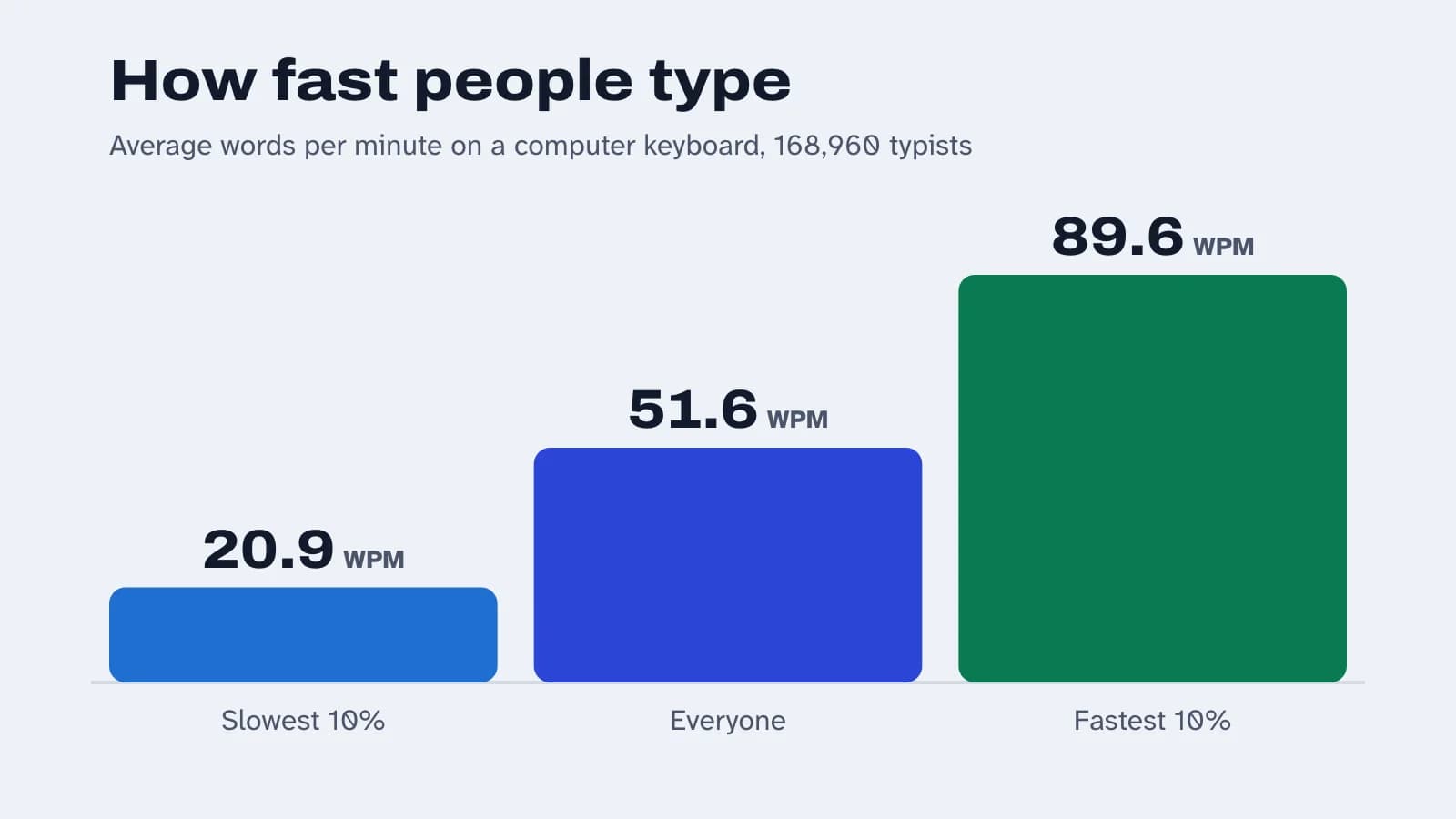
- The average typist types about 52 WPM on a computer keyboard: 51.56 WPM in a 2018 study of 168,960 typists, most of them teenagers and young adults (typing statistics).
- US federal clerk-typist jobs ask for 40 WPM on a 5-minute test with no more than three errors (US Office of Personnel Management).
Frequently asked questions
What is a good typing speed for a third grader?
By the rule of thumb, 15 WPM at 90% accuracy or better. In a two-year study of four US elementary schools, the median third grader reached 7 to 9 net WPM by the end of the year, so 10 WPM with good accuracy is solid progress.
How fast should a fifth grader type?
The rule of thumb says 25 WPM. In the same study, the median fifth grader typed 14 to 17 net WPM at the end of the year. Aim for 25, and count a speed only at 90% accuracy or better.
Does the Common Core set a typing speed?
No. The writing standards ask fourth graders to type at least one page in a single sitting, fifth graders two pages and sixth graders three. They never give a speed in words per minute.
When should students start learning to type?
The Common Core first names keyboarding in third grade, and a review of keyboarding research found the upper elementary grades a good time to start. Younger children can still learn where the keys are and how to sit; our typing lessons start with the home row.
How much practice does it take?
The same review suggests students may need 25 to 30 hours of instruction in all. Over a 180-day school year, 10 minutes a day adds up to 30 hours.
Sources
- Wisconsin Department of Public Instruction. Elementary keyboarding.
- Common Core State Standards for English Language Arts. Writing standards: W.K.6, W.1.6, W.2.6, W.3.6, W.4.6, W.5.6, W.6.6, W.7.6 and W.8.6.
- Donica, Giroux, Kim and Branson (2021). A Comparison of Two Keyboarding Instruction Methods Over 2 Years for Elementary Students. The Open Journal of Occupational Therapy 9(3).
- Freeman, MacKinnon and Miller (2005). Keyboarding for students with handwriting problems: a literature review. Physical & Occupational Therapy in Pediatrics 25(1–2).
- Dhakal, Feit, Kristensson and Oulasvirta (2018). Observations on Typing from 136 Million Keystrokes. CHI 2018.
- US Office of Personnel Management. Qualification standards for General Schedule positions: Clerical and Administrative Support Positions.