Speed and accuracy
Typing statistics: average speed, accuracy and how fast typists type
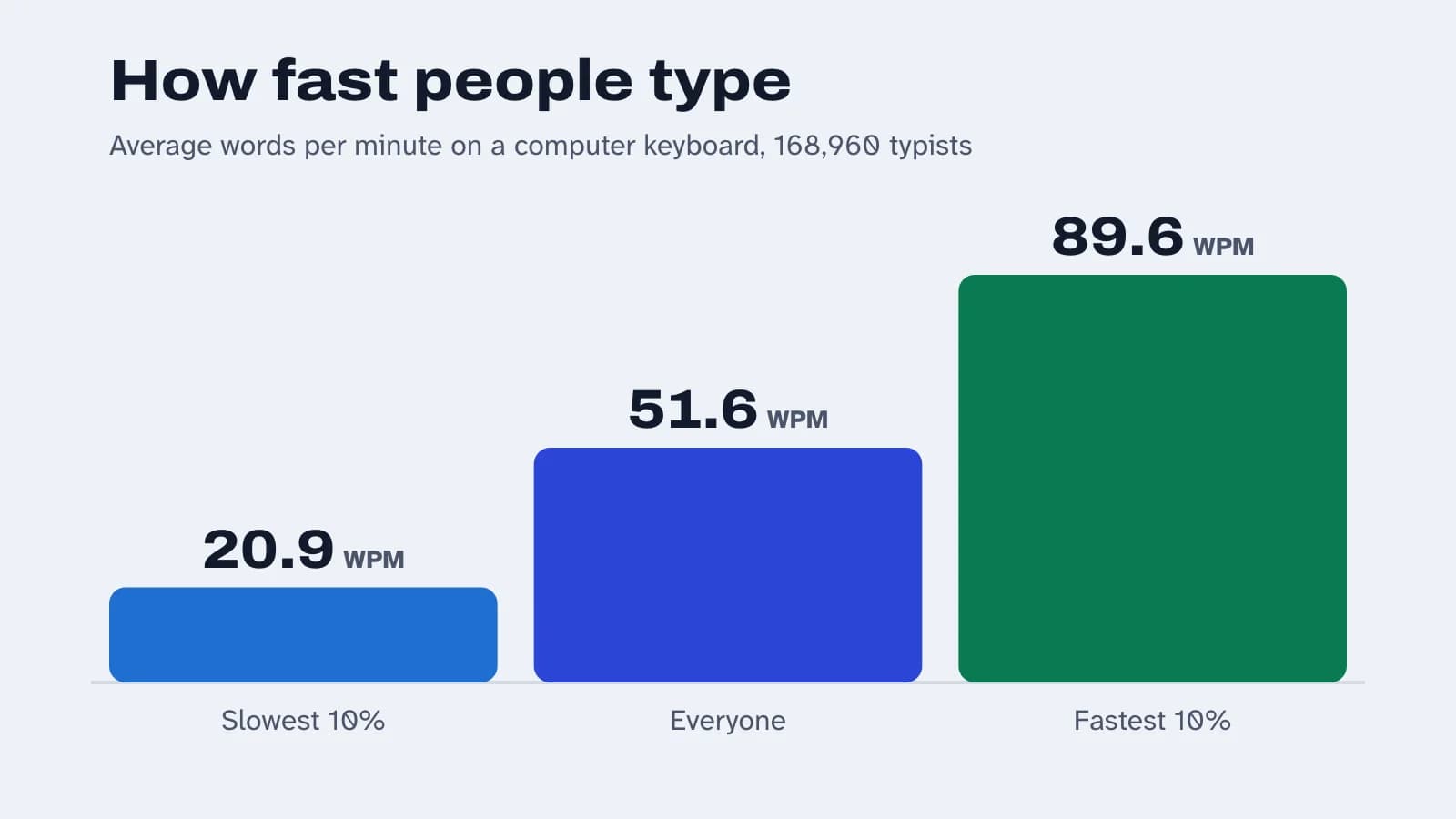
The average typist types about 52 words per minute on a computer keyboard and about 36 on a phone, according to two Aalto University studies of 168,960 and 37,370 volunteers. The fastest 10% type over 78 WPM. Typists leave about 1% of characters wrong on a keyboard and 2.3% on a phone, and the fastest press the next key before letting go of the last one on about half of their keystrokes.
On this page
Every number on this page comes from published research, listed in the sources at the end. Most come from two large online studies run by Aalto University with the University of Cambridge: one of typing on computer keyboards, one of typing on phones. A word is the standard five characters, spaces included, so 52 words per minute (WPM) is about 260 characters a minute.
Average typing speed on a keyboard
The largest public study of keyboard typing logged 136,857,600 keystrokes from 168,960 volunteers who took an online typing test (Dhakal, Feit, Kristensson and Oulasvirta, 2018). Each person copied 15 English sentences. The results:
| Statistic | Speed |
|---|---|
| Average | 51.56 WPM |
| Standard deviation | 20.2 WPM |
| Slowest 10% | under about 26 WPM |
| Fastest 10% | over about 78 WPM |
| Average of the fastest 10% | 89.6 WPM |
| Average of the slowest 10% | 20.9 WPM |
| The very fastest | 120 WPM or more |
Most people in the study were teenagers and young adults: the average age was 24.5, and three in four were between 11 and 30. 68% were in the US, 72% had taken a typing course and 98.1% used a QWERTY keyboard. They chose to take a typing test, so they may type a little faster than people in general. For what these speeds mean for you, see what is a good typing speed.
Typing speed on phones
A follow-up study measured 37,370 volunteers copying sentences on their phones (Palin, Feit, Kim, Kristensson and Oulasvirta, 2019):
- The average was 36.2 WPM, with a standard deviation of 13.2 WPM. Three in four typed under 44 WPM, and the fastest went over 80.
- People left 2.3% of characters wrong, twice the keyboard rate.
- Those who typed with two fingers or thumbs averaged 37.7 WPM; those who used one finger, 29.2. Two thumbs was the fastest way to hold the phone, at 38.0 WPM.
- People whose keyboards corrected their words automatically were faster; people who picked words from the suggestion bar were slower.
- Having taken a touch typing course for computer keyboards wasn’t linked to faster typing on a phone.
Phone typing speed by age
| Age | Average speed |
|---|---|
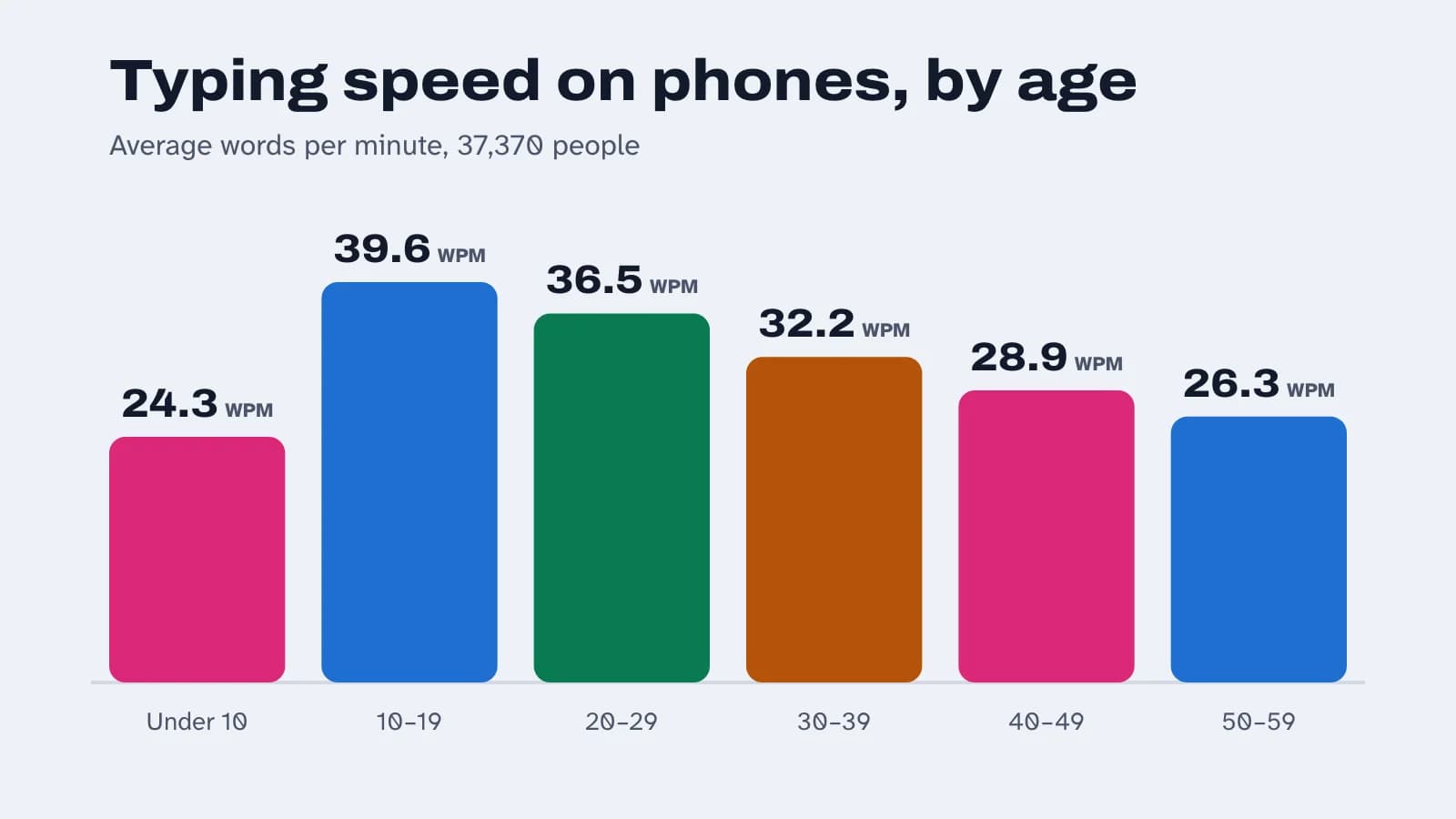
| Under 10 | 24.3 WPM |
| 10 to 19 | 39.6 WPM |
| 20 to 29 | 36.5 WPM |
| 30 to 39 | 32.2 WPM |
| 40 to 49 | 28.9 WPM |
| 50 to 59 | 26.3 WPM |
Teenagers were the fastest on phones, although they weren’t the ones who said they typed on their phones the most. The keyboard study didn’t report its speeds by age.
Mistakes and corrections
Typing fast and typing accurately go together. In the keyboard study:
- People left 1.17% of characters wrong in their final text. The fastest 10% left 0.71%, the slowest 10% left 1.78%.
- 6.3% of all keypresses were Backspace or Delete. The fastest typists pressed them for 3.4% of their keys, the slowest for 9.1%.
- On average, typists pressed 1.17 keys for every character they ended up with.
Older studies of professional typists, asked to type as fast and as accurately as they could without correcting anything, found error rates of 1.0% to 3.2%, as the same paper reports. For ways to make fewer mistakes, see how to improve typing accuracy.
How fast typists type
Speed comes less from moving fingers faster and more from how the keystrokes overlap and flow.
- Rollover. On a quarter of keystrokes, people pressed the next key before letting go of the last one. The fastest 10% did it on 49.9% of their keystrokes, the slowest 10% on 7.6%. Of all the measures in the keyboard study, this one tracked speed most closely after the time between keystrokes itself.
- Fingers. The fastest typists said they used 8.4 fingers on average, the slowest 5.3.
- Training. People who had taken a typing course averaged 54.4 WPM, those who hadn’t 49.0: a real but small difference.
- Different hands. Letter pairs typed with different hands or fingers predicted speed better than letter repeats. Classic studies of typewriter typists found pairs typed with different hands to be 30 to 60 milliseconds faster than pairs on the same hand.
A lab study of 30 everyday typists with motion capture and eye tracking (Feit, Weir and Oulasvirta, 2016) found that self-taught typists can match touch typists:
| Touch typists | Self-taught typists | |
|---|---|---|
| Average speed | 57.8 WPM | 58.9 WPM |
| Share of time looking at the keyboard | 20% | 41% |
| Fingers used | 8.5 | 6.2 |
Its fastest typists, trained or not, shared three habits: each letter always pressed by the same finger, fingers moving toward the next keys early, and hands that stayed still. Touch typists looked down half as much, which leaves the eyes free for the screen; see how to stop looking at the keyboard.
Rhythm: time between keystrokes
| Typists | Average time between keystrokes |
|---|---|
| Everyone | 239 ms |
| Fastest 10% | 122 ms |
| Slowest 10% | 481 ms |
A key was held down for 116 milliseconds on average. The professional typists of the classic typewriter studies averaged about 140 milliseconds between keystrokes and typed at 60 to 75 WPM, so a modern 70 WPM is a professional speed.
Students and schools
- The Common Core writing standards set no typing speed. They expect students to type at least one page in a single sitting in fourth grade, two pages in fifth and three in sixth (standards W.4.6 to W.6.6).
- A common rule of thumb for speed is 5 WPM times the grade, so 15 WPM in third grade and 25 in fifth, as the Wisconsin Department of Public Instruction puts it.
- Real classes are often slower. In a two-year study of 1,306 students at four elementary schools in the rural US South, the median net speed at the end of fifth grade was 14 to 17 WPM, and at the end of third grade 7 to 9 (Donica, Giroux, Kim and Branson, 2021).
- A review of keyboarding research concluded that students need to type at least as fast as they write by hand, should learn touch typing if they can, and may need 25 to 30 hours of instruction in all, starting in the upper elementary grades (Freeman, MacKinnon and Miller, 2005).
More on this, with a chart to print: typing goals by grade.
Typing speed for jobs
The US Office of Personnel Management’s qualification standard for clerical positions asks clerk-typists and office automation clerks for 40 WPM, on a 5-minute test with no more than three errors. You can take the same length of test on our 5-minute typing test.
Cite this page
TypingPractice.ai (2026). Typing statistics: average speed, accuracy and how fast typists type. https://typingpractice.ai/learn/typing-statistics. Updated November 17, 2026. For a number in your own work, please cite the study it comes from as well; each is linked above and listed below.
Frequently asked questions
What is the average typing speed?
About 52 words per minute on a computer keyboard: 51.56 WPM in a 2018 study of 168,960 typists. On a phone it’s about 36 WPM: 36.2 WPM in a 2019 study of 37,370 people.
What typing speed is in the top 10%?
About 78 WPM or more. In the 2018 study, the fastest 10% of typists were over about 78 WPM, and they averaged 89.6 WPM.
Are touch typists faster than self-taught typists?
A little, on average, but not always. In the large study, people who had taken a typing course averaged 54.4 WPM and those who hadn’t 49.0. In a lab study of 30 typists, self-taught typists were as fast as touch typists (58.9 and 57.8 WPM), but they looked at the keyboard about twice as often.
How many typing mistakes do people make?
On a keyboard, people left about 1.2% of characters wrong and pressed Backspace or Delete for about 6% of their keys. On a phone they left 2.3% wrong.
Who types fastest on a phone?
Teenagers. In the 2019 study, people aged 10 to 19 averaged 39.6 WPM on their phones, and speed went down with each decade after that, to 26.3 WPM for people in their fifties.
Sources
- Dhakal, Feit, Kristensson and Oulasvirta (2018). Observations on Typing from 136 Million Keystrokes. CHI 2018. Project page and paper (PDF).
- Palin, Feit, Kim, Kristensson and Oulasvirta (2019). How do People Type on Mobile Devices? Observations from a Study with 37,000 Volunteers. MobileHCI 2019. Project page.
- Feit, Weir and Oulasvirta (2016). How We Type: Movement Strategies and Performance in Everyday Typing. CHI 2016. Project page.
- Donica, Giroux, Kim and Branson (2021). A Comparison of Two Keyboarding Instruction Methods Over 2 Years for Elementary Students. The Open Journal of Occupational Therapy 9(3).
- Freeman, MacKinnon and Miller (2005). Keyboarding for students with handwriting problems: a literature review. Physical & Occupational Therapy in Pediatrics 25(1–2).
- Common Core State Standards for English Language Arts. Writing standards, grades K to 12.
- Wisconsin Department of Public Instruction. Elementary keyboarding.
- US Office of Personnel Management. Qualification standards for General Schedule positions: Clerical and Administrative Support Positions.