For parents
Typing for kids: when and how to start
Children can start learning to type in the early grades of elementary school, once they read simple words and their fingers can rest on the home row. A study of about 1,700 students recommends starting early, mainly to build good technique, and US Common Core standards expect fourth graders to type a full page in one sitting. Keep sessions short and frequent, teach the home row before speed, fit the desk to the child, and praise the practice rather than the score.
On this page
What age should kids learn to type?
There’s no single right age, but the research and school standards point to the early grades of elementary school.
- Starting early helps technique. Donica, Giroux and Kim (2019) followed about 1,700 students from kindergarten to fifth grade in schools that taught keyboarding in two different ways: a structured curriculum or free web-based activities. Speed and accuracy improved at every grade in both. The structured curriculum’s advantage in technique was largest from kindergarten to second grade, while in grades three to five the web activities did slightly better on technique. The authors recommend starting in the early grades, mainly so good technique comes first.
- Schools expect it by fourth grade. The US Common Core writing standards, which many states use or have adapted, ask third graders to use keyboarding skills with an adult’s help, fourth graders to type at least one page in a single sitting, fifth graders two pages and sixth graders three.
Starting before hunt-and-peck habits set in also makes life easier. In a study of adults learning to touch type, the ones who were already fastest while looking at the keys improved least once the course ended, apparently because the old habit kept winning.
Is your child ready?
Age matters less than a few practical signs. Your child is probably ready when they:
- can read and spell simple words, so practice text makes sense to them;
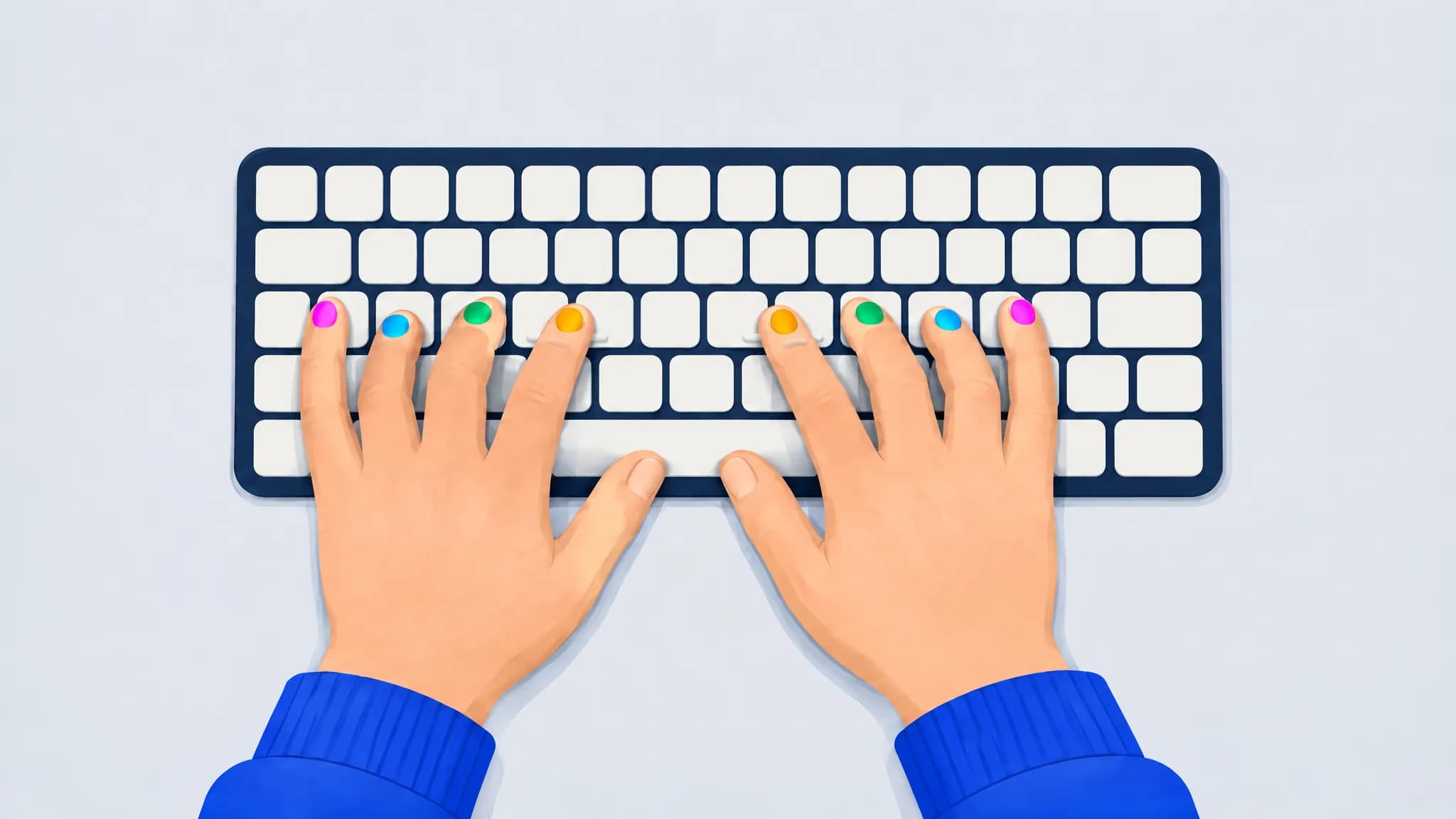
- can rest four fingers of each hand on the home row (A S D F and J K L ;) without stretching;
- can sit and focus for about ten minutes;
- want to type something: a story, a message, a school project.
If they aren’t there yet, wait a few months. Forcing it can make typing a chore.
How long should practice sessions be?
Short and frequent. We suggest ten to fifteen minutes at a time, a few days a week, for most young children; stopping while it’s still fun matters more than reaching a time.
The research on adults points the same way. In a classic study of trainee typists, people who practiced one hour a day learned the keyboard in fewer hours of practice than those who practiced four hours a day in two sessions. Young children usually focus for less time than adults, so their sessions should be shorter still.
Guidelines for children’s computer use from Straker and colleagues (2010) also recommend mixing time at the screen with whole-body movement, so a typing session works best as one short part of the day, not an hour in a chair.
Teach the home row first
Speed can wait. The habits that make typing fast later are learned first:
- Fingers on the home row. Show your child the bumps on F and J; index fingers go there and the other fingers follow. Our finger placement chart shows which finger owns each key.
- One row at a time. Practice words made of home-row letters, like “sad”, “glad” and “flask”, then add the top row, then the bottom row.
- Eyes on the screen. Gently discourage looking down. A light cloth over the hands helps some children, and an on-screen keyboard can help at the start, as long as it’s turned off as they improve; our guide to not looking at the keyboard explains why.
- Accuracy over speed. Praise clean typing, and let speed come by itself.
Set up a desk that fits
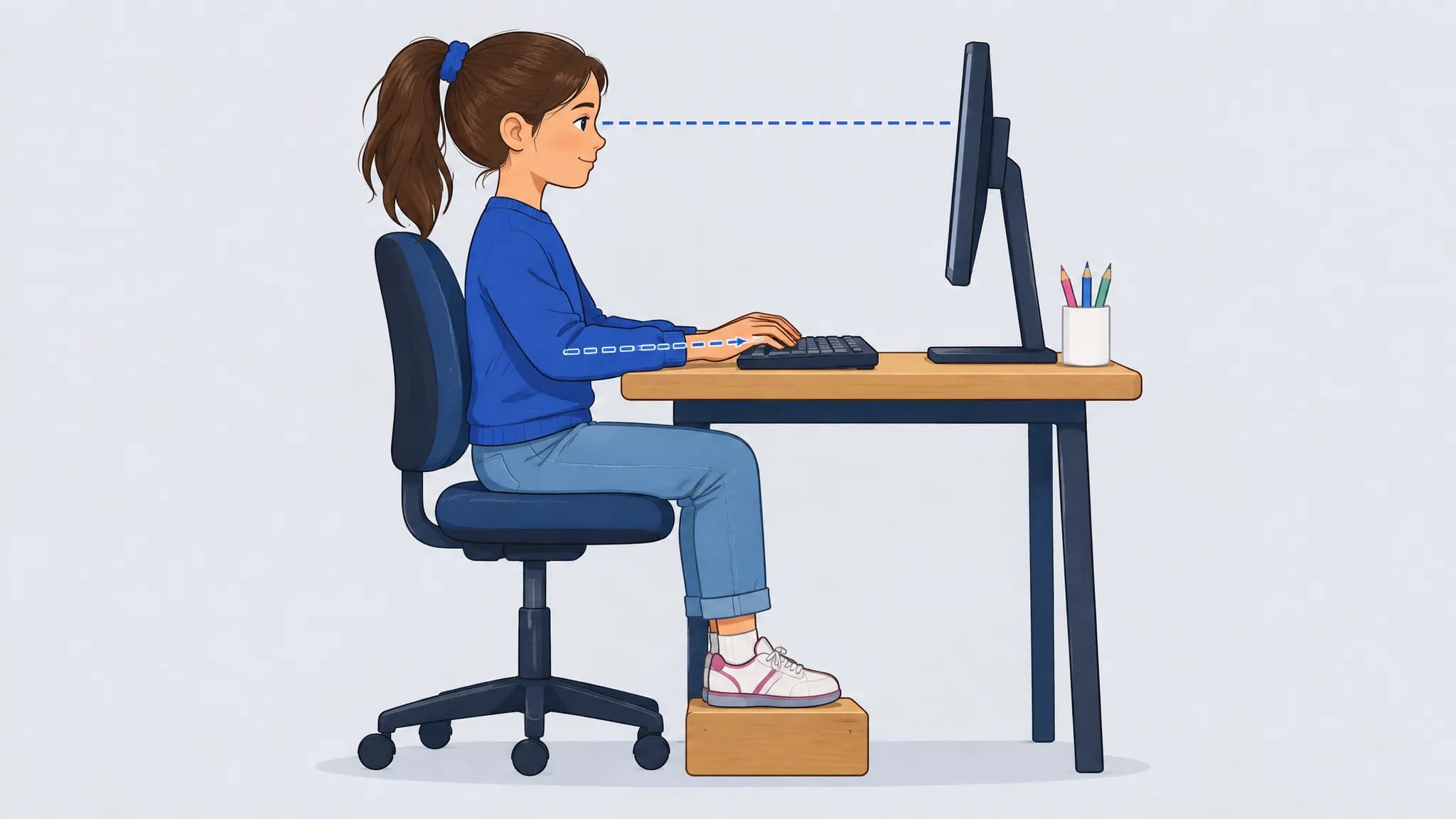
Children use computers in all sorts of positions. A Curtin University team led by Professor Leon Straker found that children used notebook computers at a desk only 34% of the time, and recommended an external keyboard and mouse for notebook use at a desk, plus teaching good posture. Their guidelines cover adjusting the chair, desk, screen and keyboard to the child. In practice:
- Feet supported, on the floor or a footrest, so they aren’t dangling.
- Elbows at about keyboard height, with wrists straight rather than bent up or down.
- A full-size or external keyboard rather than a cramped laptop on the knees.
- Breaks and movement between sessions. If something aches, stop and adjust the setup.
Keep it encouraging
Keep it low-pressure. A few habits help:
- Praise the practice, not the talent. “You kept your fingers on the home row the whole time” is more useful than “you’re a natural”. In a well-known set of studies, Mueller and Dweck (1998) found that fifth graders praised for being smart persisted less and enjoyed problems less after a setback than children praised for their effort. A large replication with Chinese schoolchildren by Li and Bates (2019) didn’t find those effects, so the evidence is mixed, but specific praise for effort costs nothing.
- Compare them with themselves. Last week’s score is a better yardstick than a classmate’s. Our typing test and habits page keep that history in your browser, with no account needed.
- Type real things. A short story, a letter to a grandparent or a list for the weekend can be more motivating than drills.
Frequently asked questions
What age should a child learn to type?
Most children can start in the early grades of elementary school, around the time they read simple words comfortably. A study of about 1,700 students recommends starting in the early grades to build good technique, and the US Common Core standards expect fourth graders to type a page in one sitting.
How long should a child practice typing each day?
We suggest ten to fifteen minutes for most young children. Several short sessions a week work better than one long one, and it’s best to stop while it’s still fun.
Is typing bad for handwriting?
There’s no reason to drop one for the other. For the youngest children, handwriting may matter for learning letters: in a study by Longcamp, Zerbato-Poudou and Velay (2005), older preschoolers who practiced writing letters by hand recognized them better than those who practiced typing them. Evidence for older children is limited, and there’s no need to choose: children can learn both.
Should kids learn to type on a tablet or a keyboard?
A physical keyboard, if they’re learning to touch type. Typing on a touchscreen is a different skill, usually done with one or two fingers or thumbs, and a large study of phone typing found average speeds well below those on keyboards. Finger placement and home-row habits only carry over to a real keyboard.
What is a good typing speed for a 10-year-old?
There’s no reliable research norm for typing speed by age. Schools set their own targets, and they vary. For young typists, accuracy and good technique matter more than speed; speed follows once the home row and the reaches are automatic. Our typing speed guide shows how teenagers and adults compare.
Sources
- Donica, Giroux and Kim (2019). Effectiveness of two keyboarding instructional approaches on the keyboarding speed, accuracy, and technique of elementary students. The Open Journal of Occupational Therapy 7(4).
- Common Core State Standards Initiative. English Language Arts Standards, Writing: Grade 3, Grade 4, Grade 5 and Grade 6, standard 6.
- Yechiam, Erev, Yehene and Gopher (2003). Melioration and the transition from touch-typing training to everyday use. Human Factors 45(4).
- Baddeley and Longman (1978). The influence of length and frequency of training session on the rate of learning to type. Ergonomics 21(8).
- Straker, Maslen, Burgess-Limerick, Johnson and Dennerlein (2010). Evidence-based guidelines for the wise use of computers by children: physical development guidelines. Ergonomics 53(4).
- Curtin University (2010). Parents warned about children’s notebook computer use.
- Mueller and Dweck (1998). Praise for intelligence can undermine children’s motivation and performance. Journal of Personality and Social Psychology 75(1).
- Li and Bates (2019). You can’t change your basic ability, but you work at things, and that’s how we get hard things done: testing the role of growth mindset on response to setbacks, educational attainment, and cognitive ability. Journal of Experimental Psychology: General 148(9).
- Longcamp, Zerbato-Poudou and Velay (2005). The influence of writing practice on letter recognition in preschool children: a comparison between handwriting and typing. Acta Psychologica 119(1).
- Palin, Feit, Kim, Kristensson and Oulasvirta (2019). How do People Type on Mobile Devices? Observations from a Study with 37,000 Volunteers. MobileHCI 2019.