For teachers
Winter typing race kit for the last week before break
A ready-made class race for the last week before winter break. Copy one of the twelve winter passages below into a class race, at the length that suits your grade, and follow the 40-minute plan: a warm-up, three rounds, a final and certificates. Students join with a code and a first name, with no accounts, and the passages are about winter weather and nature, not any holiday, so they suit every class.
The last days before winter break are hard to fill and easy to enjoy. A class typing race gives students something lively to do at the keyboard, and the practice is real: every key has to be typed right, and the accuracy you set decides who places. This kit has everything you need for a 40-minute race:
- Twelve winter passages, short, medium and long, for grades 2 to 8, ready to paste.
- A one-page plan to print, with what to do the day before and minute by minute.
- A winter certificate to print and fill in, and the certificates the race makes for you.
The race itself is a class race: free, no ads, and students join with a code and a first name.
The plan
- The day before. Open typingpractice.ai/race on a student computer to make sure your school’s filter allows it; if not, send your IT team our setup page for schools. Pick three passages below, one of each length, or three of the length that suits your class.
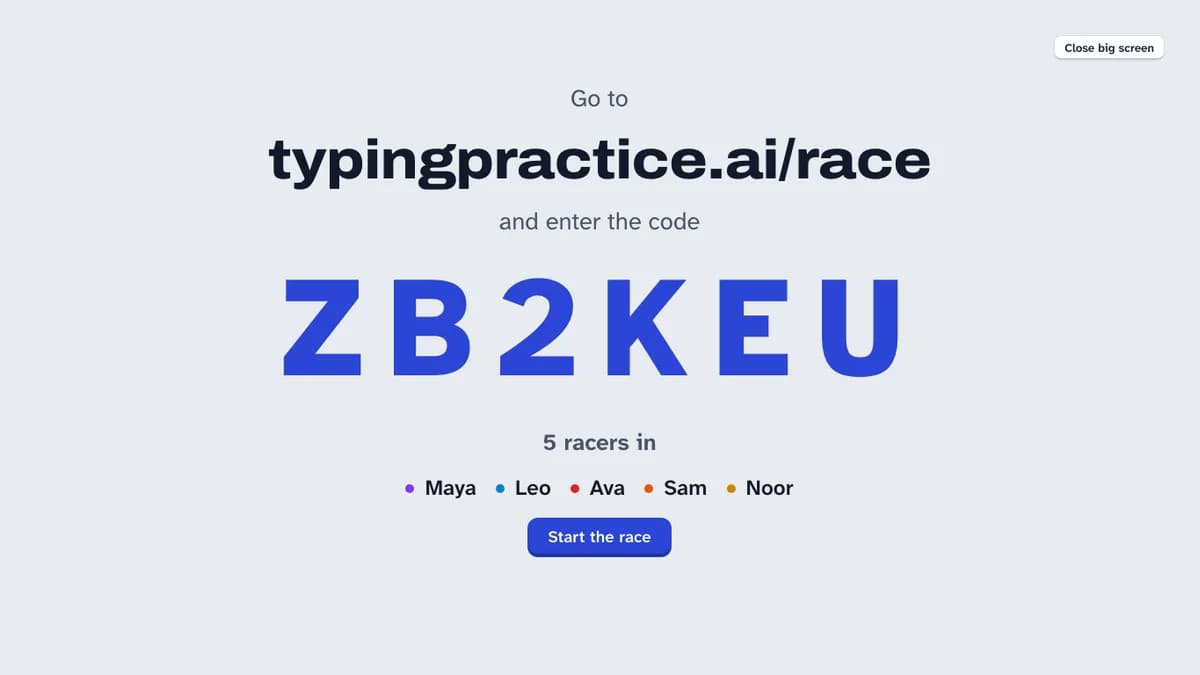
- Set up (5 minutes). Sign in, start a class race and press Show on a big screen. Students join with the code and their first name.
- Warm up (5 minutes). A practice round with a short passage. No scores yet.
- Three rounds (15 minutes). Paste a passage with Use your own text before each round: short, then medium, then long. Set Accuracy that counts to 90%, or 95% for older students.
- The final (10 minutes). Everyone races the long passage once more, or only the top typists while the class cheers.
- Certificates (5 minutes). Press Print certificates after the final, or hand out the winter certificate below with each student’s best speed.
The passages
Each passage is plain text that pastes straight into a class race. Press Copy text, then in your class race open For a class, choose Use your own text, paste it and press Use this text. They are about winter weather, animals and cozy days, not any holiday, and one is about winters without snow.
Short: Grades 2 and 3
Snow fell all night. In the morning, the yard was soft and white. We put on our boots and hats and ran outside to make the first tracks.
The pond is frozen. Ducks walk across the ice and look a little surprised. We stay on the path and wave to them from the bench.
My mittens are wet, my nose is cold, and my cheeks are pink. It is time for warm soup, and I am ready for it.
Winter days are short. The sun goes down before dinner, so we turn on the lamps and read a book together.
Medium: Grades 4 and 5
Not every winter has snow. In some places, winter means gray skies and cool rain. Kids still splash in puddles, wear warm jackets, and come home to a hot drink. Winter looks different all over the world, but it always means a change in the weather.
Many animals have a plan for winter. Bears sleep in dens, squirrels hide nuts, and some birds fly south where it is warmer. Others, like the snowshoe hare, grow a white coat so they can hide in the snow. Which plan would you choose?
Our class made a list of winter jobs. Someone has to shovel the walk, fill the bird feeder, and check that the plants by the window get enough light. We took turns, and by Friday every job was done.
The first snowflake landed on my sleeve. I looked closely and saw six tiny arms, each one covered in little branches. A minute later it melted, and I wished I could have kept it a little longer.
Long: Grades 6 to 8
On the shortest day of the year, the sun rises late and sets early. This day is called the winter solstice, and it comes in December in the northern half of the world. After it, each day grows a little longer. People have watched for this turning point for thousands of years, because it means that brighter days are on their way back.
Snow is mostly air. A fresh layer of fluffy snow can be more than ninety percent air, which is why it feels so light when you scoop it up. That trapped air also makes snow a good blanket: it keeps the ground underneath warmer than the air above, and small animals use it to stay safe all winter.
Ice skating looks easy until you try it. The first time, most people wobble, wave their arms, and hold on to the wall. After a few laps, their feet learn the rhythm, and the wall is not needed anymore. Typing is a lot like that: slow and careful at first, then smooth and quick with practice.
When the weather turns cold, a warm drink tastes even better. Some people make hot cocoa, some make tea with honey, and others make spiced cider. Whatever is in your cup, the best part might be wrapping your hands around it, watching the steam rise, and talking with the people around you.
At 15 words per minute, a short passage takes under two minutes; at 30, a long one takes about two.
Certificates
The race makes certificates for you: after a race, Print certificates prints a page for each student who finished, with their speed, accuracy and the date. For something more wintry, print the winter certificate and fill it in by hand. It has room for awards beyond first place, such as most improved.
Frequently asked questions
Are the passages about any holiday?
No. They are about winter weather, nature and cozy days, so every student can enjoy them, wherever they celebrate, and one of them is about places where winter brings rain instead of snow.
Which passages suit my grade?
The short ones (21 to 28 words) suit grades 2 and 3, the medium ones (37 to 46 words) grades 4 and 5, and the long ones (52 to 63 words) grades 6 to 8. A strong younger class can try the next length up.
Can I change a passage?
Yes. Paste it into Use your own text and edit it before pressing Use this text. A class race takes 40 to 1,200 characters.
We teach south of the equator. Does the kit still work?
Yes, just save it for June, when winter comes to you.